Choosing the right Solar Flood Light manufacturer requires more than comparing wattage and prices. Global buyers must examine lighting performance, battery quality, photovoltaic efficiency, weather resistance, and after-sales support. A bright sample can still disappoint after several cloudy nights. That matters in warehouses, farms, roads, construction sites, and remote properties.
Solar lighting specialist and SolarAid founder Jeremy Leggett has often stressed, “Solar is the future.” His point remains practical: reliable sunlight-powered equipment can reduce grid dependence when designed for real conditions. Yet the phrase needs careful interpretation. Solar Flood Light performance depends on local weather, installation angle, battery chemistry, and daily operating hours. Marketing claims may overlook these details.
This guide introduces leading manufacturers for international buyers. It considers product engineering, certifications, production capacity, customization, warranty policies, and field experience. It also looks beyond polished catalogs. Does the manufacturer publish battery data? Are lumen claims tested? Can replacement parts be supplied years later? These questions expose weak suppliers quickly.
Some comparisons remain imperfect. Manufacturers use different testing methods, and project conditions vary widely. A light that performs well in Dubai may struggle during a rainy season in Southeast Asia. Buyers should request samples and verify results independently. Small details matter, such as cable sealing, mounting brackets, motion-sensor sensitivity, and controller protection.
The best supplier is not always the cheapest. It is the one that balances dependable illumination, honest specifications, service capability, and long-term value. That balance shapes every section of this manufacturer overview.
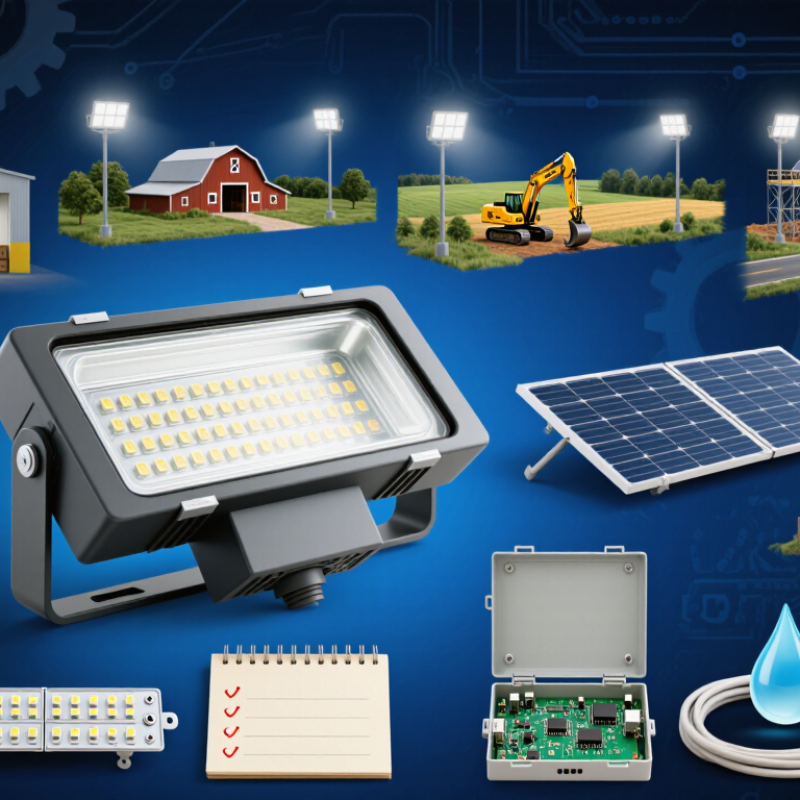
Solar flood lights are outdoor lighting systems that convert sunlight into usable electricity. A photovoltaic panel charges an internal battery during daylight hours. After sunset, the stored energy powers efficient LED modules. Their wide beam can illuminate driveways, farms, construction areas, entrances, and storage yards.
Global buyers choose these lights because they can operate without underground power cables. Installation is often faster, especially in remote locations or temporary facilities. They may also reduce wiring costs and ongoing electricity expenses. Motion sensors can increase battery life by activating light only when movement occurs. Weather-resistant housings help protect components from rain, dust, and temperature changes. Small details matter. Beam angle, mounting height, battery capacity, and panel efficiency affect real performance.
From practical purchasing experience, product selection must match the local climate and daily lighting needs. A unit designed for sunny weather may perform poorly during long cloudy periods. Buyers should check autonomy ratings, charging time, battery replacement options, and documented safety testing. Inadequate sizing remains a common mistake. A brighter lamp is not always a better lamp if its battery empties before morning. Solar lighting is not maintenance-free. Panels need occasional cleaning, and batteries eventually lose capacity. Reliable suppliers should provide clear specifications, installation guidance, warranty terms, and test documentation instead of vague performance claims.
Top Solar Flood Light Manufacturers for Global Buyers
Key Features for Comparing Solar Flood Light Manufacturers
Comparing solar flood light manufacturers requires more than checking lumen claims. Ask for measured brightness, beam angle, battery capacity, and panel output. A reliable supplier provides test reports with clear conditions. Examine the light at dusk, not only in a bright showroom. A 10,000-lumen claim may look impressive, but poor optics can leave dark ground areas.
Weather resistance matters in real installations. Check the IP rating, housing material, cable seals, and mounting hardware. For coastal sites, ask about corrosion testing. Battery cycle data is also important. Some suppliers disclose performance after hundreds of charge cycles, while others provide vague promises. Request samples and inspect the controller, screws, and wiring yourself. Small parts often reveal manufacturing discipline.
Service quality can decide a project’s success. Compare warranty terms, spare-part availability, replacement procedures, and response times. Ask whether the manufacturer supports custom motion sensors, timers, remote control, or dimming schedules. Production capacity should match your order volume without weakening quality checks. I once trusted a low price and overlooked inconsistent charging between samples. That mistake delayed installation. A better evaluation includes factory records, independent inspection, packaging tests, and a written specification sheet. Leave room for doubt. Supplier claims still need verification.
A practical benchmark for global buyers based on measurable product and supply capabilities. Higher scores indicate stronger suitability for large-scale, international procurement.
The comparison considers five purchasing dimensions: lighting performance, battery durability, weather protection, certification readiness, and customization capability. Buyers should verify test reports, IP ratings, battery cycle-life data, regional certifications, warranty terms, and production capacity before selecting a supplier.
Solar flood light sourcing now depends on regional capability, not only low pricing. IRENA’s Renewable Capacity Statistics 2024 recorded 473 GW of renewable capacity added worldwide in 2023. Solar contributed about 346 GW. This scale supports strong component ecosystems across East Asia, South Asia, and Southeast Asia.
East Asian factories often provide advanced LED optics, lithium battery packs, and automated testing. South Asian suppliers may offer flexible assembly and strong regional customization. Southeast Asian plants can support diversified production and export logistics. However, location alone proves little. Supplier audits should examine battery aging tests, photovoltaic conversion efficiency, IP ratings, and thermal performance.
The IEA’s Renewables 2024 report expects solar PV to drive most renewable growth through 2030. That forecast increases pressure for stable components and traceable quality records. Published figures also lag reality.
Tips: Request ten-unit samples before volume orders. Test illumination after three rainy nights. Check lux levels at ground height, not only laboratory claims. Ask for salt-spray results in coastal projects. Confirm whether rated battery capacity is usable capacity. A factory may meet the specification on paper, yet perform unevenly outdoors. Require independent reports, production photos, and serial-number records. Also review warranty exclusions carefully; vague wording creates avoidable disputes.
Global demand for solar lighting is expanding quickly. IRENA’s Renewable Capacity Statistics 2024 reported 346 GW of new solar capacity installed worldwide in 2023. This growth increases pressure on flood light manufacturers to prove safety, not merely advertise brightness.
Reliable suppliers should provide test reports against IEC 60598-1 and IEC 60598-2-3 for lighting safety. IEC 60529 IP ratings also matter. An IP65 enclosure should resist dust and water jets, while weak seals can fail after repeated outdoor exposure. Ask for reports from an independent laboratory. A factory declaration alone is less convincing.
Battery documentation deserves equal attention. Lithium systems should show compliance with IEC 62133-2 or IEC 62619, depending on the battery design and application. UN 38.3 testing supports safer international transport. Photobiological safety under IEC 62471 can reduce risks from intense LED output. Electromagnetic compatibility testing should also match the destination market.
Look closely at the evidence. Does the report identify the exact model, battery, driver, and production revision? Does the sample match the shipped product? These details are often overlooked. Certifications can expire, and waterproof performance may decline after installation, especially near saltwater or heavy dust. That is the uncomfortable part. A polished certificate cannot replace traceable quality control, realistic thermal testing, and clear after-sales procedures. Suppliers should also explain regional conformity requirements, including applicable electrical, environmental, and recycling rules.
| Evaluation Dimension | Applicable Standard, Regulation, or Requirement | What Buyers Should Verify | Recommended Evidence | Typical Risk if Not Verified |
|---|---|---|---|---|
| General luminaire safety | IEC 60598-1:2020, General requirements and tests for luminaires | Electrical insulation, creepage and clearance distances, protective earthing where applicable, mechanical strength, wiring, and abnormal-operation performance | Test report identifying the exact model, rated input, battery configuration, and applicable edition of the standard | Electric shock, overheating, premature failure, or difficulty demonstrating product conformity |
| Floodlight-specific construction | IEC 60598-2-5, Particular requirements for floodlights | Suitability of the enclosure, mounting arrangement, adjustment mechanism, cable entry, and thermal performance for floodlight use | Product safety test report and installation instructions covering the supplied mounting hardware | Unsafe mounting, water entry, unstable aiming, or excessive housing temperature |
| Ingress protection | IEC 60529 IP Code | The tested IP rating for the complete assembled product, including lens, housing, cable glands, switches, connectors, and battery compartment | IP test report from a competent laboratory; installation conditions must match the tested configuration | Moisture or dust entering the enclosure, corrosion, short circuits, and reduced outdoor service life |
| Photovoltaic module durability | IEC 61215 for design qualification and type approval of terrestrial PV modules | Module technology, rated power, test conditions, degradation assumptions, and whether the certificate covers the actual module construction | Module certificate or laboratory report with model number, technology, and electrical ratings | Lower energy harvest, accelerated degradation, and insufficient battery charging in poor weather |
| PV module electrical safety | IEC 61730-1 and IEC 61730-2 for PV module safety qualification | Protection against electric shock, fire, mechanical hazards, and environmental stresses at the module level | Safety qualification documentation matching the supplied PV module and its construction class | Insulation breakdown, fire risk, or unsafe handling during installation and maintenance |
| Battery safety | IEC 62619 for industrial lithium secondary cells and batteries; IEC 62133-2 may apply to portable sealed secondary lithium cells and batteries | Battery chemistry, nominal voltage, capacity, protection circuitry, operating temperature, charge limits, and the standard applicable to the battery type | Battery safety report, battery-management-system specifications, and traceable cell or pack identification | Overcharging, overheating, capacity loss, swelling, thermal runaway, or transport restrictions |
| Transportation of lithium batteries | UN 38.3 testing requirements for lithium cells and batteries transported by air, sea, road, or rail | Whether the battery design and configuration have passed the required transport tests and whether shipping documents are available | UN 38.3 test summary, dangerous-goods classification, packaging information, and applicable shipping instructions | Shipment delays, carrier rejection, customs issues, or unsafe transport incidents |
| Electromagnetic compatibility | CISPR 15 for lighting equipment emissions and IEC 61547 for lighting equipment immunity requirements | Conducted and radiated emissions, immunity to electromagnetic disturbances, and compatibility of the charge controller, driver, and control electronics | EMC test report for the complete product, not only an individual LED or controller | Radio interference, unwanted flicker, control malfunction, or failure to meet destination-market requirements |
| Photobiological safety | IEC 62471, Photobiological safety of lamps and lamp systems | Risk group classification, optical power, beam angle, installation height, and exposure conditions for users and bystanders | Photobiological safety assessment with LED type, optical configuration, and measured operating condition | Potential eye or skin exposure concerns, especially for high-intensity or narrowly focused products |
| European market access | CE marking requirements, including applicable EU electrical, EMC, RoHS, and other legislation; RoHS Directive 2011/65/EU as amended | Correctly identified applicable directives or regulations, technical documentation, restricted-substance compliance, and an EU Declaration of Conformity where required | Signed Declaration of Conformity, technical file summary, test reports, and product labeling or user instructions | Customs delays, product withdrawal, enforcement action, or inability to sell legally in the EU |
| United States market access | FCC Part 15 for applicable unintentional radiators; additional electrical safety requirements may depend on the product, installation, and authority having jurisdiction | FCC compliance for digital or switching electronics and any required safety listing or field evaluation for the intended installation | Supplier’s FCC compliance records, EMC test report, installation instructions, and applicable safety certification documentation | Import or installation problems, electromagnetic interference, or rejection by project inspectors |
| Light-output performance | IES LM-79 for measured performance of solid-state lighting products; TM-21 may be used for LED lumen-maintenance projections | Measured lumens, input power, efficacy, color temperature, color rendering, beam distribution, and test conditions | Independent photometric report or integrating-sphere report for the complete luminaire at its normal operating condition | Overstated brightness claims, poor area coverage, and incorrect sizing of lighting projects |
| Quality management | ISO 9001:2015 quality management system requirements | Whether the certificate covers the relevant manufacturing site and scope, and whether production uses documented inspection, traceability, and corrective-action processes | Valid certificate issued by an accredited certification body, factory audit results, inspection plans, and batch records | Inconsistent batches, uncontrolled component substitutions, and weak after-sales traceability |
| Environmental and installation suitability | Manufacturer-declared operating limits supported by environmental, thermal, corrosion, and mechanical testing appropriate to the project | Ambient-temperature range, wind exposure, salt-mist conditions, mounting loads, battery autonomy, charging time, and seasonal solar availability | Datasheet, installation manual, environmental test reports, site-specific lighting calculations, and warranty terms | Poor winter performance, corrosion, structural damage, short autonomy, or warranty disputes |
Note: The applicable requirements depend on the product design, battery chemistry, destination market, installation environment, and whether the luminaire is portable, fixed, or connected to other equipment.
Choosing among top solar flood light manufacturers requires more than comparing catalog prices. In field evaluations, I inspect the product and factory process together. A reliable supplier should explain panel wattage, battery chemistry, LED output, charging time, and expected runtime clearly. Ask for test reports, sample units, production photos, and traceable component records. Vague answers are warning signs. So is an unusually low quotation.
Test a sample outdoors for several nights. Record illumination, motion-sensor response, charging recovery, and battery performance after cloudy weather. Check the housing, cable seals, screws, and mounting bracket by hand. An IP rating should match the installation environment, not merely appear on a brochure. Request independent laboratory reports and confirm their report numbers. Also review quality-control steps, including incoming inspection and final testing. A factory tour, even by live video, can reveal storage problems or rushed assembly.
Manufacturer reliability also depends on communication after payment. Confirm warranty coverage, replacement-part availability, packaging strength, and response times before signing an order. Ask how defects are logged and corrected. I prefer suppliers that share limitations openly. No system performs perfectly in every climate. A coastal site may need stronger corrosion protection, while cold weather can reduce battery capacity. One evaluation may still miss hidden weaknesses. Repeat testing with a second sample when the project is important. Keep written records of every claim, revision, and approval.
East Asian factories often offer advanced LED optics, lithium battery packs, and automated testing. South Asian suppliers may support flexible assembly and local customization. Southeast Asian plants can provide varied production and export logistics. Location alone proves little.
Request at least ten sample units. Test them outdoors after three rainy nights. Measure light at ground height. Check charging recovery after cloudy weather. One sample can mislead you.
Record ground-level lux readings during several nights. Check motion-sensor response and runtime. Compare actual brightness with laboratory claims. Outdoor performance may vary unevenly.
Request independent laboratory reports, production photographs, and serial-number records. Reports should identify the exact model, battery, driver, and revision. Confirm the sample matches the shipped product. Paperwork can still be incomplete.
Outdoor lights face dust, water jets, heat, and salt air. A suitable enclosure rating helps protect internal parts. Inspect cable seals, screws, and housing edges. Waterproof performance may decline after installation.
Ask for the battery chemistry, rated capacity, usable capacity, charging time, and expected runtime. Request battery safety evidence and transport test records. Cold weather may reduce capacity. Rated capacity is not always usable capacity.
Ask about incoming inspection, battery aging tests, thermal testing, and final inspection. A live video tour may reveal rushed assembly or poor storage. Check production records and component traceability. Factory claims need practical evidence.
Confirm warranty coverage, exclusions, replacement parts, packaging strength, and response times. Ask how defects are recorded and corrected. Keep written records of every approved revision. I may still miss hidden weaknesses, so repeat testing for important projects.
Solar Flood Light systems use photovoltaic panels to convert sunlight into electricity, storing energy in batteries for automatic nighttime illumination. They offer global buyers an energy-efficient, low-maintenance solution for streets, parking areas, construction sites, gardens, and other outdoor spaces where reliable lighting and reduced wiring costs are important. When comparing manufacturers, buyers should examine brightness, battery capacity, solar panel efficiency, lighting duration, motion-sensor performance, weather resistance, materials, product lifespan, and customization options.
Manufacturing regions differ in production scale, technical expertise, lead times, and supply-chain capabilities, so buyers should evaluate suppliers according to project requirements rather than price alone. Quality standards, electrical safety certifications, ingress protection ratings, battery safety, testing procedures, and warranty terms are essential indicators of product reliability. A dependable manufacturer should provide clear technical documentation, consistent quality control, transparent communication, samples for testing, realistic delivery schedules, and responsive after-sales support. By carefully reviewing these factors, global buyers can select a capable partner and reduce operational risks.

Jianheng