Choosing the best Solar Flood Lights begins with the site, not the product label. A driveway, warehouse wall, and remote garden need different beam angles, mounting heights, and operating schedules. The International Energy Agency’s Renewables 2024 report confirms solar PV remains the fastest-growing renewable power source. That growth supports better panel efficiency, battery management, and outdoor lighting components. However, impressive solar statistics do not guarantee reliable illumination after three cloudy nights.
LED performance matters just as much. The U.S. Department of Energy’s Energy Savings Forecast of Solid-State Lighting report identifies substantial long-term energy-saving potential from LEDs. In practical terms, efficient LEDs can produce bright security coverage while using a smaller battery. Look for measured lumens, tested runtime, and a replaceable or well-protected battery. Also check IP65 or higher protection, because dust and sideways rain can expose weak seals quickly. Small details matter.
No single design wins every location. Motion-activated models reduce wasted energy near quiet paths, while dusk-to-dawn units suit entrances needing steady visibility. Split-panel lights often perform better where the fixture stays shaded, although they require more careful cable placement. IEA PVPS Trends reports continued expansion in global solar deployment, yet local weather still controls daily charging. That limitation is easy to overlook. Buyers should compare winter sunlight, nighttime temperature, battery chemistry, and warranty terms before choosing. This guide evaluates those factors through practical use, manufacturer specifications, and recognized lighting guidance, rather than brightness claims alone.
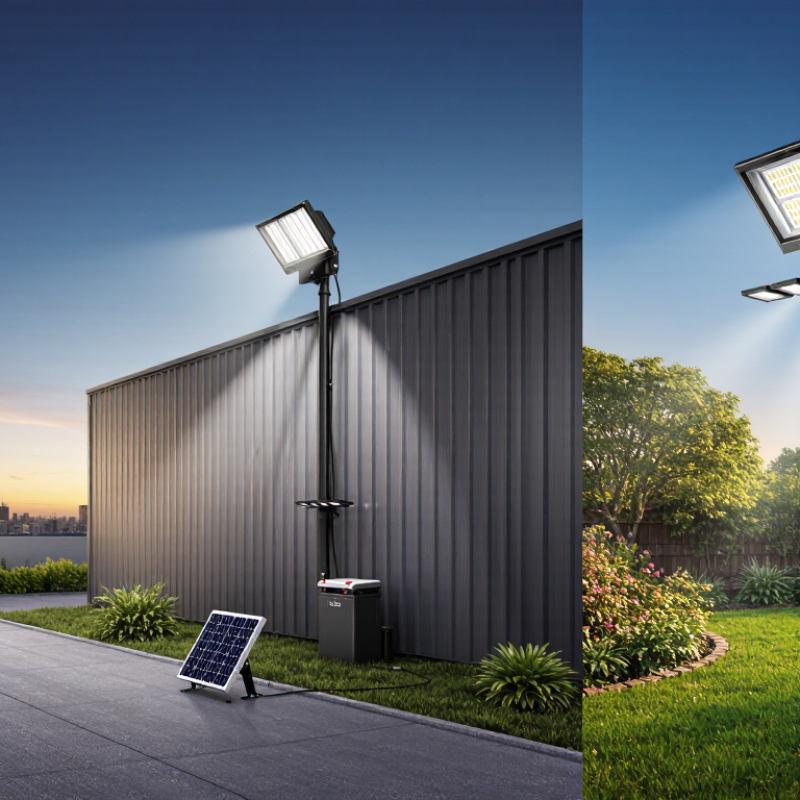
What Is the Best Type of Solar Flood Lights?
Types of Solar Flood Lights and Their Core Differences
Solar flood lights differ mainly in panel design, sensor function, brightness, and installation flexibility. All-in-one models place the panel, battery, and lamp in one housing. They install quickly on a garage wall or garden post. However, the panel may receive poor sunlight under an eave. That weakens night-time performance.
Split-type flood lights connect the lamp to a separate solar panel. A longer cable allows the panel to face direct sunlight. This type suits shaded walls, narrow courtyards, and covered entrances. Installation takes more planning. Cable placement also needs protection from rain, animals, and accidental pulling.
Motion-activated lights conserve stored energy by operating only when movement is detected. They work well beside paths and driveways. Dusk-to-dawn lights provide steady illumination throughout the night. Their brightness may fall before sunrise, especially during winter or cloudy weather. Some adjustable models offer different brightness levels and beam angles. A wide beam covers a patio, while a narrow beam reaches a gate.
Check the lumen output, battery capacity, charging time, and weather-resistance rating together. A high lumen number means little if the battery is undersized. I once focused too heavily on brightness and ignored panel placement. The light looked impressive for two nights, then became unreliable. That mistake still matters. Good selection depends on sunlight, coverage area, winter conditions, and how often people pass the sensor.
| Type | Solar Panel Arrangement | Typical Operating Mode | Typical Runtime Characteristics | Best-Suited Applications | Core Advantages | Main Limitations |
|---|---|---|---|---|---|---|
| Integrated Solar Flood Light | The solar panel, battery, LED module, and controller are built into one housing. | Usually dusk-to-dawn dimming, with optional motion-activated high brightness. | Often designed for approximately 6–12 hours of nighttime operation after a good day of charging; cloudy weather can reduce output. | Driveways, entrances, patios, garden paths, and general residential security lighting. | Simple installation, fewer cables, compact appearance, and generally lower installation effort. | The panel and light must be positioned together, so shaded locations may not charge efficiently. |
| Split Solar Flood Light | The solar panel is separate from the light and connected by a cable. | Can provide continuous low-level lighting, motion-activated illumination, or timed operation. | Usually offers greater placement flexibility; actual runtime depends on panel exposure, battery capacity, and lighting level. | Large yards, walls under eaves, shaded facades, remote sheds, and locations requiring a south-facing or unobstructed panel. | The panel can be installed in direct sunlight while the floodlight is placed where illumination is needed. | Requires cable routing and two mounting locations; installation is more involved than an integrated design. |
| Motion-Activated Solar Flood Light | Available in both integrated and split-panel configurations; commonly includes a PIR motion sensor. | Operates at a low brightness or remains off, then switches to higher brightness when movement is detected. | Short activation periods conserve battery power and may support more consistent operation during low-sunlight periods. | Security zones, garages, side passages, stairways, gates, and entrances. | High light output is available when needed while reducing unnecessary overnight energy consumption. | The sensor may be triggered by pets, moving branches, or passing traffic; detection performance depends on placement and temperature. |
| Dusk-to-Dawn Solar Flood Light | Usually uses an integrated light sensor to detect ambient brightness and activate automatically at night. | Turns on at dusk and off at dawn; some models reduce brightness to extend battery life. | Runtime varies with season, weather, battery condition, and the selected brightness level. | Walkways, signs, garden areas, building exteriors, and locations needing predictable nighttime visibility. | Automatic operation provides consistent convenience without requiring manual switching. | Continuous operation can drain the battery faster than motion-only lighting, especially during winter or extended cloudy weather. |
| Adjustable Multi-Head Solar Flood Light | Typically integrates multiple LED heads with a central solar panel or uses a separate panel. | May combine dusk-to-dawn lighting with motion activation and adjustable brightness. | Can distribute available light across several directions; higher total brightness generally requires more stored energy. | Driveways, corners, broad walls, courtyards, and areas requiring coverage in more than one direction. | Flexible beam positioning and wider coverage than a single fixed floodlight. | Larger housing, potentially more complex adjustment, and greater energy demand at maximum brightness. |
| High-Output Solar Flood Light | Usually uses a larger external panel, a higher-capacity battery, or both to support stronger illumination. | Commonly uses motion activation or scheduled high-output periods to control energy consumption. | Maximum brightness may be available for shorter periods; sustained high output requires sufficient daily solar charging. | Large driveways, commercial perimeters, construction areas, farm buildings, and wide outdoor spaces. | Greater illumination potential and wider coverage when adequate panel exposure and battery capacity are available. | Usually costs more, requires stronger mounting, and may perform poorly if the panel is undersized or heavily shaded. |
| Weather-Resistant Solar Flood Light | May be integrated or split-panel; the key distinction is enclosure protection rather than panel layout. | Operating modes vary, but outdoor models commonly include automatic dusk sensing and optional motion detection. | Performance depends on temperature, rainfall, dust, panel cleanliness, and available sunlight. | Exposed outdoor locations such as fences, gardens, parking areas, and building exteriors. | Designed for outdoor exposure when the enclosure, seals, and mounting hardware are appropriately rated. | A water-resistance rating does not guarantee protection against flooding, improper installation, or long-term water immersion. |
Selection note: For most homes, an integrated motion-activated model is convenient and energy-efficient. Choose a split-panel design when the light and the sunniest charging location are far apart, and choose a higher-output or multi-head model when wider coverage is more important than compact installation.
The best type depends on sunlight, coverage, weather, and sensor use. An all-in-one model installs quickly. A split-panel model performs better in shaded locations. There is no perfect choice.
Choose it for a sunny garage wall, garden post, or open fence. The panel, battery, and lamp share one housing. Installation is simple. Nearby shade can weaken nighttime performance.
Choose a split-panel model when the lamp sits under an eave or beside a shaded wall. Its separate panel can face direct sunlight. Protect the cable from rain, animals, and pulling.
Motion-activated lights conserve stored energy beside paths and driveways. Dusk-to-dawn lights provide steady illumination throughout the night. Their brightness may decrease before sunrise. Winter clouds can make this worse.
Photovoltaic cells convert sunlight into electricity during the day. A controller manages charging. The battery stores energy for nighttime use. Darkness activates the LED array.
Check lumens and beam angle together. A wide beam suits patios and driveways. A narrow beam reaches gates and paths. Extremely bright light can cause glare.
Place the panel away from shadows between 9 a.m. and 3 p.m. Clean dust every few months. Keep the panel angled toward useful sunlight. Cloudy weather still reduces runtime.
Check lumen output, battery capacity, charging time, operating hours, and weather resistance. Look for sealed connections and sturdy brackets. Maximum brightness figures are estimates, not promises. I once ignored panel placement and regretted it.
Choosing the best Solar Flood Lights depends on understanding their different designs, lighting ranges, battery systems, and control features. Some models provide wide-area illumination for driveways and yards, while others are designed for security, pathways, or temporary outdoor use. Most units convert sunlight into electrical energy through a solar panel, store it in a rechargeable battery, and automatically power the light when darkness is detected. Performance is influenced by brightness, solar panel efficiency, battery capacity, motion detection, lighting modes, weather resistance, and operating time.
The ideal Solar Flood Lights should match your location, available sunlight, coverage requirements, and seasonal weather conditions. Before installation, choose a position with unobstructed sunlight and aim the light toward the intended area. Regularly cleaning the panel, checking mounting stability, and inspecting the battery can help maintain reliable performance. With suitable features, correct placement, and basic maintenance, solar flood lighting can provide efficient, convenient, and long-term outdoor illumination without relying on a wired power connection.

 Jianheng